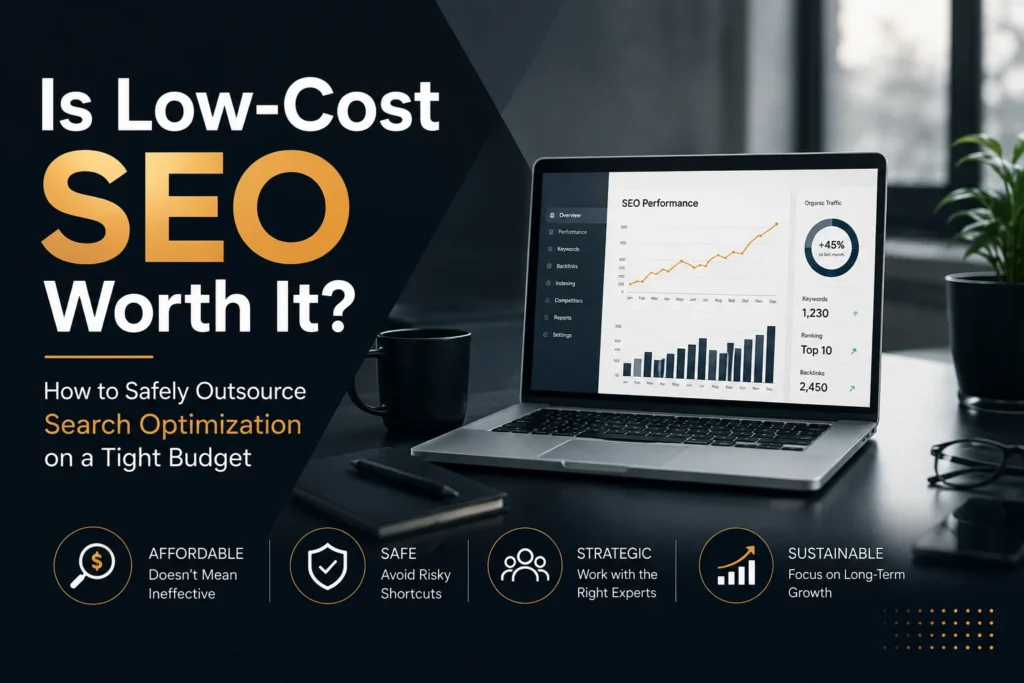
If you’ve ever tried getting SEO done for your business, chances are you’ve had that moment. You start with a simple Google search. Maybe something like “SEO services for small business” or “how much does SEO cost.” Then you talk to a few agencies. And suddenly you’re looking at proposals that cost more than what you originally planned to spend on marketing for the next few months.
That’s usually when people start searching for Affordable SEO Services for Small Businesses. Not because they’re trying to be cheap. Mostly because they’re trying to be practical.
A small business owner doesn’t wake up thinking, “Today I feel like spending a huge amount on SEO.” Most are already paying for a dozen things. Staff salaries. Inventory. Office expenses. Software subscriptions. Advertising. Maybe even managing everything themselves. So naturally they start wondering if there is a way to make SEO work without spending a fortune. And honestly… yes, there is.
Affordable SEO vs Cheap SEO: They’re Not the Same Thing
But this is where things get messy because people often mix up affordable SEO and cheap SEO like they’re the same thing. They’re not. Not even close.
Affordable SEO is usually about focusing on the stuff that actually matters.
- Figuring out what people are searching
- Making sure website pages make sense
- Improving content
- Fixing obvious issues
- Showing up better in local searches
- Tracking what’s working and what isn’t
That’s usually where most of the value comes from anyway.
Cheap SEO is often something else entirely. It’s the SEO version of buying a suspiciously cheap product online and then wondering why it stopped working after two weeks.

What SEO Really Is (Without All the Complicated Terms)
The funny thing is, SEO itself isn’t nearly as complicated as some people make it sound. People hear terms like technical SEO, search intent, indexing, crawlability, schema, authority signals and suddenly it feels like learning a new language.
But if you strip all of that away, SEO is basically helping search engines understand what your website is about and helping the right people find it. That’s the whole game. Everything else is just layers on top of that.
Why Affordable SEO Makes Sense for Small Businesses
One reason affordable SEO has become such a popular option is because a lot of businesses simply need somewhere to start. Not everyone can invest heavily from day one.
Actually, many businesses delay SEO completely because they think they need a massive budget before they begin. Meanwhile competitors keep publishing content.
- They keep improving pages.
- They keep collecting reviews.
- They keep building visibility.
And little by little, they start showing up more often in search results. That’s one thing people sometimes underestimate about SEO.
SEO Results Compound Over Time
A blog post written today might still bring visitors months later. A service page optimized this month might still be generating leads next year. Paid ads don’t usually work like that. When ad spend stops, traffic often drops pretty quickly too. SEO is slower, sure. But it can keep working long after the actual work is done.

Why Some Low-Cost SEO Services Get a Bad Reputation
Of course, that’s assuming the SEO is being done properly. And that’s where low-cost SEO gets a mixed reputation. Because not every provider is following the same approach.
You’ve probably seen the promises. Everyone has.
- “Guaranteed first-page rankings.”
- “Thousands of backlinks.”
- “Instant SEO growth.”
- “Results in seven days.”
Things like that. And every time I see one of those offers, I kind of wonder the same thing. If someone could genuinely guarantee Google’s rankings, why would they be selling SEO packages?
The reality is pretty simple.
- Nobody outside Google controls Google.
- Good SEO providers understand that.
- The less trustworthy ones tend to sell certainty.
- That’s often where problems start.
Common Shortcuts That Usually Don’t Deliver Long-Term Results
A lot of extremely cheap SEO services rely on shortcuts. Not always, but often enough.
Things like:
- Huge backlink packages
- Automated content
- Copy-paste articles
- Keyword stuffing
- Random directory submissions
These things can sound productive when listed on a proposal. But they don’t necessarily create long-term value. Sometimes those tactics create a temporary jump. Sometimes they don’t. But very rarely are they the reason a website grows consistently over several years.
How to Outsource SEO Without Wasting Your Budget
If you’re outsourcing SEO while watching your budget carefully, one of the easiest things you can do is simply ask people what they’ll actually be doing.
- Not what the package is called.
- Not how many buzzwords are included.
- Just ask what work gets done.
- The answer should be understandable.
You shouldn’t feel like you need an SEO certification just to follow the explanation.
Start Small Instead of Buying the Biggest Package
And honestly, many businesses don’t need giant SEO packages right away anyway.
- A website audit.
- Some keyword research.
- Basic optimization.
- A content plan.
Those things alone can provide a solid starting point. Then you build from there. That’s usually easier than jumping straight into an expensive long-term commitment.
Don’t Ignore Reporting
Something else that’s worth mentioning because it gets overlooked quite a bit… Reporting. SEO shouldn’t feel mysterious. You should know what’s happening.
Questions like:
- Traffic up or down?
- Rankings improving or not?
- What content was created?
- What issues were fixed?
- What progress was made?
Should have clear answers. If every report looks like a complicated spreadsheet from another dimension, it’s probably not helping much. The businesses that tend to get the most value from SEO are often the ones that actually understand what’s being done.
Why Content Still Matters So Much
And then there’s content. Honestly, content keeps showing up in almost every SEO conversation for a reason. Google exists to help people find useful information. So websites that consistently publish useful information naturally have more opportunities to appear in search results. That doesn’t mean pumping out endless articles nobody wants to read. We’ve all seen those blogs. Five thousand words saying almost nothing.
The goal is:
- Answering questions
- Helping people solve problems
- Creating something worth reading
Sometimes a single genuinely useful article performs better than ten rushed articles written just to hit a publishing quota. For businesses on a limited budget, that’s actually good news. Because quality tends to matter more than quantity.
Low-Cost SEO Tactics That Often Work Surprisingly Well
Local SEO
Local businesses have opportunities too. Actually, some of the easiest wins often happen locally.
Things like:
- An updated Google Business Profile
- Accurate business information
- Real customer reviews
- Location-focused keywords
None of that sounds exciting. Nobody brags about updating their business hours online. But those things often make a difference.
Long-Tail Keywords
The same goes for long-tail keywords. A lot of businesses immediately want to rank for the biggest keyword in their industry. The problem is everyone else wants that too.
Sometimes it’s smarter to focus on the specific searches customers are actually making. Those searches may have lower volume. But they often attract people who already know what they’re looking for.
Basic Technical SEO
Technical SEO sounds intimidating, but plenty of improvements are surprisingly straightforward.
- Better page speed
- Mobile-friendly pages
- Clear headings
- Organized site structure
- Clean URLs
Nothing groundbreaking there. Yet all of it contributes to a better experience. And search engines tend to like websites that create better experiences.
Helpful SEO Tools That Don’t Cost a Fortune
The good news is that improving SEO doesn’t automatically mean buying expensive software either.
Some useful tools include:
- Google Search Console
- Google Analytics
- Google Trends
- Ubersuggest
- AnswerThePublic
- Rank Math
- Yoast SEO
- Screaming Frog (Free Version)
You can learn a lot without spending huge amounts on tools.
Where Admardi Fits In
Which brings us back to businesses like Admardi. Most companies looking for Affordable SEO Services for Small Businesses aren’t chasing overnight success stories.
They’re usually looking for something much simpler.
- A strategy that fits their budget
- A team that explains things clearly
- Work that actually gets done
- Growth that feels sustainable
That’s generally what makes SEO valuable in the first place.
- Not tricks.
- Not hacks.
- Not magic formulas.
- Just consistent improvements over time.
- Piece by piece.
- Page by page.
- Month by month.
So, Is Low-Cost SEO Worth It?
Yeah, probably. For a lot of small businesses it’s actually the most sensible place to begin. The trick is making sure affordable doesn’t become suspiciously cheap. Because those aren’t the same thing.
A realistic strategy, useful content, transparent communication, solid optimization, and a little patience will usually take a business much further than any promise of overnight rankings. And that’s probably the least exciting answer you’ll hear about SEO. But it’s also the one that tends to be true.