Here’s a situation almost every artist in the tricity will recognise. Your track does well on YouTube. Two lakh views in a few weeks, comments coming in, people sharing it. Then you open Spotify for Artists out of curiosity and find eleven hundred streams.
Same song. Same week. Same audience, supposedly.
It’s probably the single most common question a Music Promotion agency in Tricity gets asked, and we hear it from artists across Chandigarh, Mohali and Panchkula almost every month. The answer isn’t that Spotify is broken, or that your song underperformed. The two platforms simply work in completely different ways, and unless somebody actively builds a bridge between them, the audience you win on one doesn’t cross over to the other.
Two platforms, two entirely different animals
YouTube is a discovery machine. It’s India’s biggest music platform by a wide margin, and it runs on visuals, thumbnails, search and suggested videos. Somebody finds your song because the algorithm slotted it after a track they were already watching, or because the thumbnail caught them. They watch once, enjoy it, move on.
Spotify runs on repeat listening. It cares about saves, library adds, whether people finish the track or skip at twenty seconds, and how often they come back. Its algorithmic playlists, Release Radar and Discover Weekly, are built largely around followers and listening behaviour, not view counts. So a YouTube view and a Spotify stream measure two different things. One is attention. The other is intent.
There’s a money difference too, and it’s worth being clear about. Neither platform pays much per play in India, but the economics behave differently. YouTube earns through ad revenue and Content ID, which depends heavily on viewership volume. Spotify pays a per-stream rate that is significantly lower in India than in Western markets, but streams repeat, and catalogue tracks keep earning for years. Since 2024, Spotify has also required a track to cross 1,000 streams in a twelve-month window before it generates recorded royalties at all.
Which is exactly why the crossover matters. Your YouTube audience is largely domestic. Your diaspora listeners in Canada, the UK and Australia, the ones who pay far more per stream, are mostly on Spotify and Apple Music. Punjabi music has enormous reach abroad and a lot of tricity artists are leaving that on the table.
What an agency actually does to close the gap
1. Fix the technical foundation first
This is unglamorous and it comes before everything.
Your Official Artist Channel on YouTube needs to be set up properly, which usually means delivering releases through a distributor and consolidating your scattered topic channels, art tracks and uploads into one verified home. Your artist name has to be spelled identically everywhere. Your ISRC codes and metadata should match across both platforms so the systems recognise your catalogue as one body of work.
Most independent artists we meet have two or three fragmented YouTube presences and a Spotify profile they’ve never claimed. Fixing that alone changes what the algorithms can do for you.
2. Sync the release calendar
A lot of artists drop the video first and put the song on streaming weeks later, or the other way round. That splits the momentum in half.
Coordinated releases go live on the same day, usually a Friday, with the Spotify pitch submitted through Spotify for Artists at least seven days in advance. Spotify recommends that minimum, and most agencies push for two to four weeks, because that pitch data teaches the algorithm what your song is even if editorial passes on it.
Pre-saves run alongside, so the streaming side has some engagement waiting on day one instead of starting from zero.
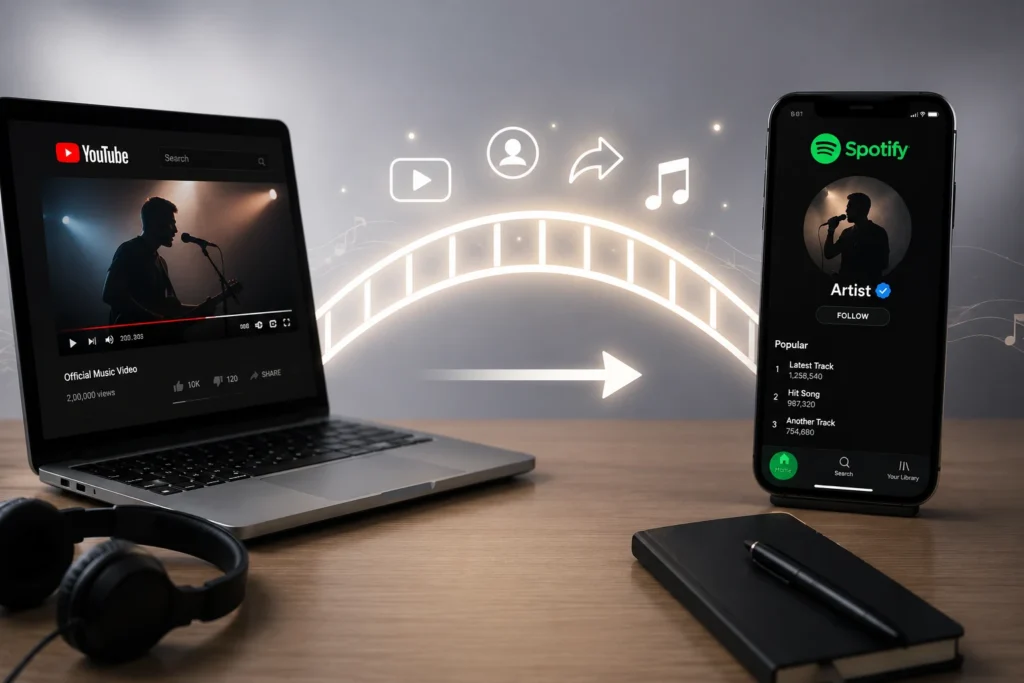
3. Turn your YouTube page into a doorway
Your video is the busiest room you own. Most artists put nothing in it that points anywhere.
The fixes are simple. A smart link in the first line of the description, above the fold, before the “read more” cut. A pinned comment with the same link. End screens and cards in the final seconds of the video. A channel banner link. And crucially, an actual ask, spoken or written, telling people the song is on Spotify.
Smart links matter here because they also tell you which platform people are choosing, which is data you can use on the next release.
4. Use Shorts and Reels as the real bridge
This is where most of the crossover now happens.
When your audio is attached to a Short or a Reel, it becomes discoverable as a sound, and people who find it that way tend to go looking for the full track on their streaming app of choice. A good agency builds short-form assets around a specific hook from the song rather than just cutting a random fifteen seconds, and seeds them consistently for weeks after release instead of only on launch day.
This is an important part of Music Promotion in Mohali, Chandigarh and India, where short-form content can help independent artists reach both local listeners and audiences beyond the Tricity.
5. Make Spotify worth arriving at
Getting someone there is half the job. Keeping them is the other half.
That means a claimed and complete profile, a Canvas loop on your tracks, an Artist Pick, a decent bio and photos, and existing catalogue arranged so a new listener has something to move on to. Most importantly it means converting them into a follower, not just a listener, because followers are what feed Release Radar every Friday for the rest of your career.
6. Read the numbers and adjust
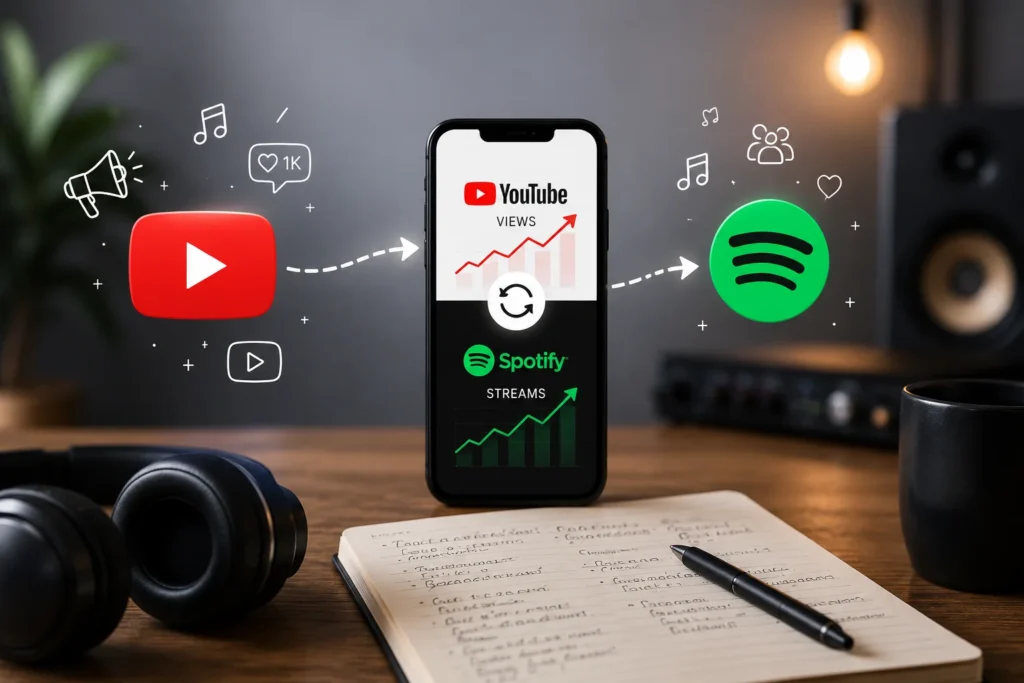
Smart link click-through tells you whether your YouTube audience is even trying to cross over. Spotify save rate tells you whether they stayed. YouTube retention tells you where people drop off in the song, which is genuinely useful creative feedback for the next one.
One thing worth saying plainly: bought views and purchased streams break all of this. Spotify has tightened enforcement on artificial streaming considerably since 2024, including financial penalties charged to distributors over flagrant bot activity, and it can mean takedowns or withheld royalties. Any agency promising guaranteed numbers is selling you a liability.
Why Admardi is worth choosing
Admardi works on releases as one connected campaign rather than as separate platform jobs, which is precisely where most independent artists lose ground.
That means the foundation gets handled properly first, from your Official Artist Channel and metadata to a claimed, finished Spotify profile. It means release calendars planned in advance, with pitches submitted early and pre-saves running, rather than a scramble two days before a drop. It means short-form content built to actually drive discovery, and every YouTube asset pointing somewhere useful. And it means reporting that talks about save rates, follower growth and click-through, not just view counts that look impressive and earn very little.
There’s also value in working with a team that knows this specific market. The tricity has a serious music ecosystem, particularly in Punjabi music, with its own studio network, its own release culture, and a diaspora audience that behaves nothing like the domestic one. That understanding is hard to outsource.
For artists looking for Music Promotion in Chandigarh, Music Promotion in Mohali, or professional music promotion across India, having a team that understands both the local market and wider streaming audience can make the release strategy much more effective.
If you have a release coming up, the best time to plan it is before the master is finished, not after the video is live.
Have a look at Admardi and start the conversation early.